





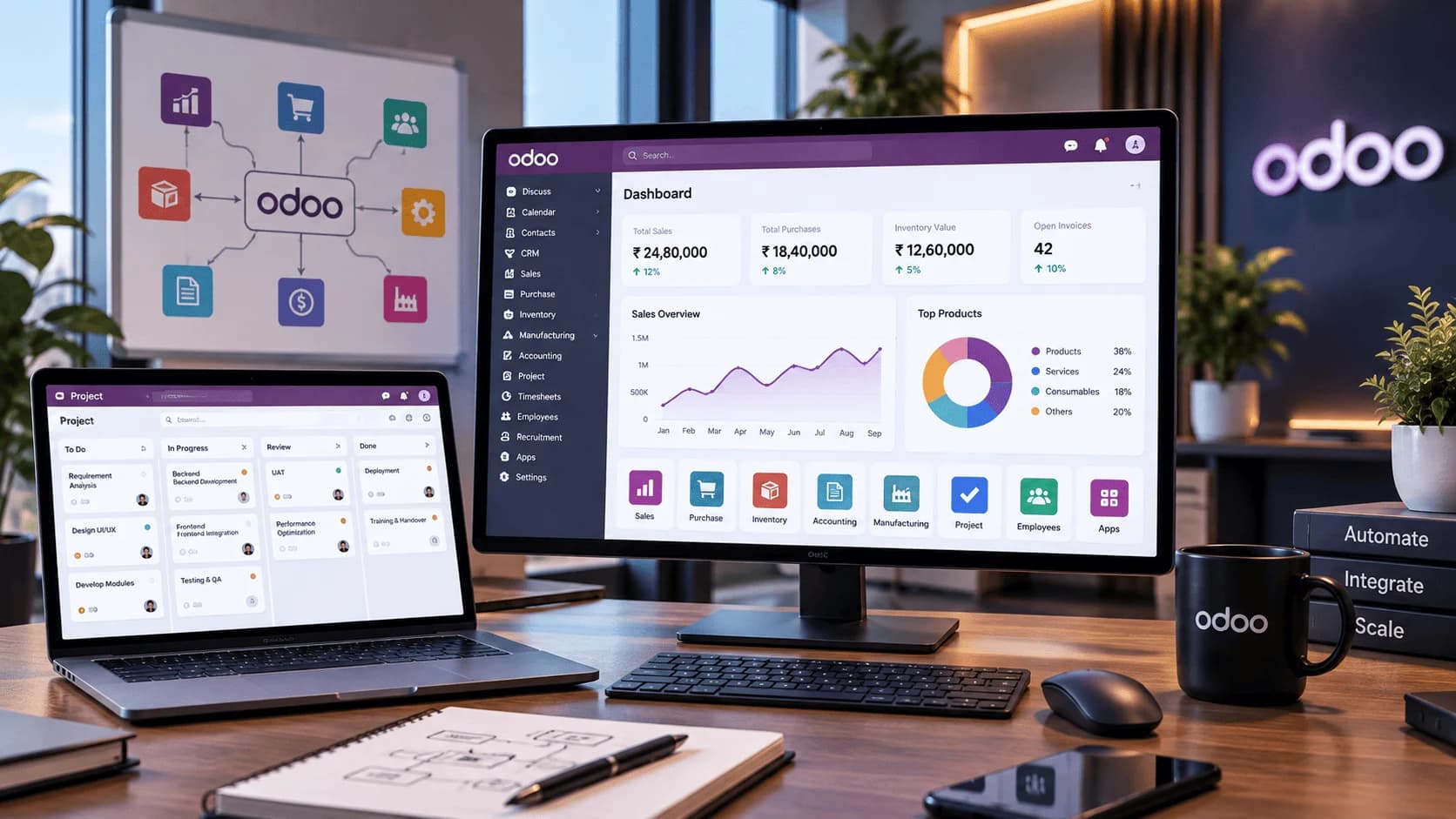







A straightforward MVP might be a relatively lean project. But a feature-rich business or enterprise application? That's a different beast entirely — more design, more engineering, more testing, more infrastructure, more integration work. Let's break down the major factors that influence mobile app development costs in Australia.
How Much Does Mobile App Development Cost in Australia?
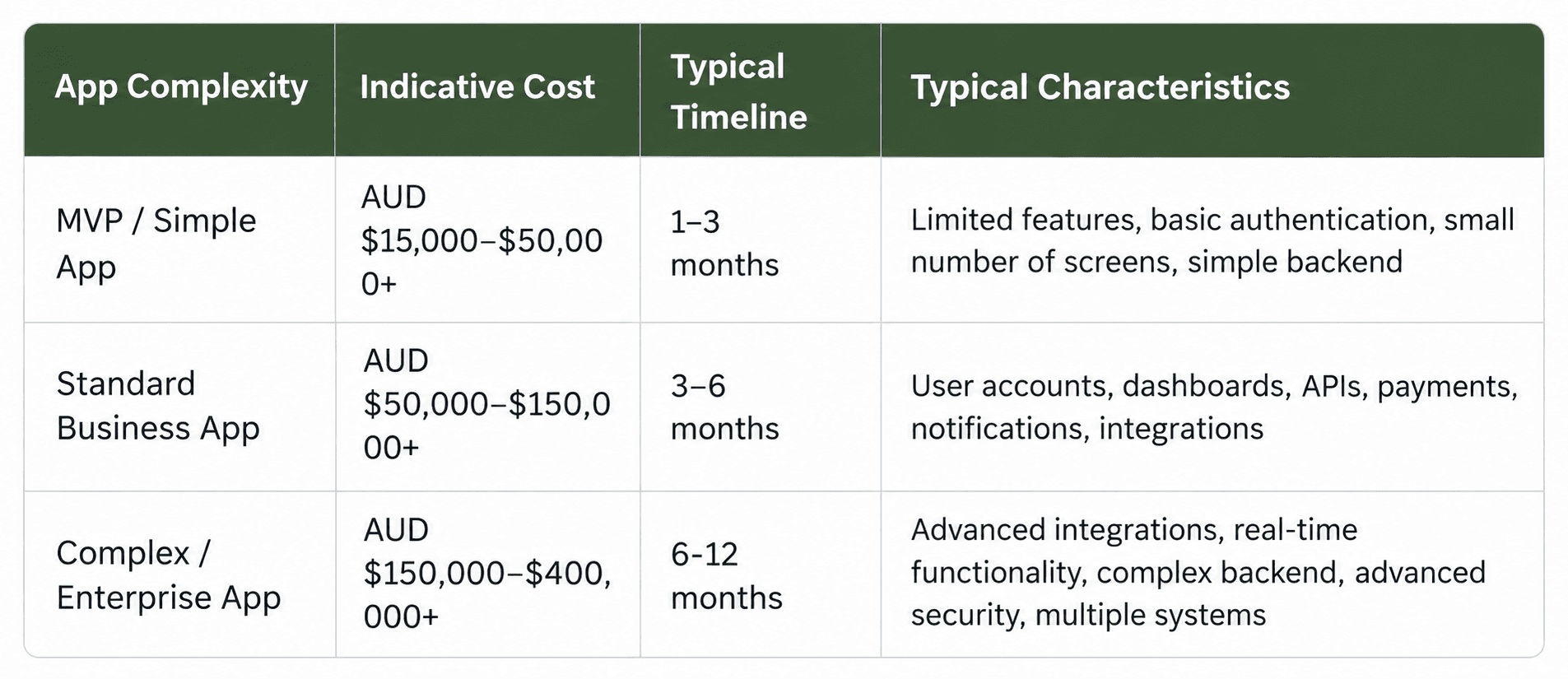
There's no fixed price tag for developing a mobile application. Your budget depends on what the app actually needs to do, who's going to use it, which platforms it'll run on, and how it connects with your other systems. The ranges below are indicative planning estimates based on our research. They're not fixed quotations or universal Australian market prices — think of them as a starting point for your budget conversations.
What Determines the Cost of Developing a Mobile App?
Several factors come into play when pricing out an app — and no two projects are quite the same. The scope of what you're building, the platforms you need to support, the features and integrations involved, the design work required, and the backend architecture all shape the final figure. Ongoing support and maintenance matter too, though those are usually treated as separate from the initial build cost. It's also worth noting that a mobile app development company in Australia will typically assess these factors during discovery, which is why two businesses with similar-sounding app ideas can end up with very different quotes. Let's walk through the big ones.
1. Hourly Development Rates in Australia
Where your development team is based makes a significant difference. Onshore Australian agencies typically range from around AUD $150 to $330+ per hour for boutique firms. Some enterprise consultancies charge $500+ per hour. Senior freelancers might charge somewhere between $80 and $150+ per hour. Offshore development can have lower direct rates, but you may end up wearing additional coordination and management overhead. These are market examples, not fixed industry rates — always do your own due diligence.
2. Platform Strategy
Do you need an iOS app, an Android app, or both? Frameworks like Flutter and React Native can support both platforms through a shared development approach. That can potentially reduce duplicated effort compared with building separate native codebases. The research suggests potential savings of roughly 30% to 40% in suitable projects — but that's an indicative estimate, not a guaranteed saving. Every project is different.
3. Features and Integrations
This is where things can get interesting — and expensive. Basic secure authentication might fall in the AUD $2,000–$8,000 range. But complex capabilities like interactive maps, live chat, or AI functionality can add $20,000+ each. These are just illustrative examples. The actual costs depend entirely on implementation complexity.
4. UI/UX Design
Custom interfaces, complex user journeys, prototypes, animations, accessibility requirements, and multiple user roles can all increase design and development effort. But here's the thing: investing in early UI/UX work can identify usability problems before they become expensive development changes. It's money well spent.
5. Backend Development
Business and enterprise applications often need more than a pretty front end. Think authentication, databases, APIs, business logic, cloud infrastructure, administration tools, real-time data, and integrations. Backend requirements can have a major effect on your total cost, so don't underestimate this piece.
6. Third-Party Integrations
Need your app to talk to your ERP? Your CRM? Payment gateways? Maps? Analytics? Accounting software? Communication platforms? Every integration adds development effort. The complexity depends on the APIs involved, authentication requirements, data mapping, security considerations, testing needs, and any limitations the third-party provider imposes. For businesses running Odoo, Odoo ERP development services are often part of the picture, since the app needs to connect with inventory, sales, accounting and other core systems.
7. Security and Compliance
If your app handles sensitive information, you'll need additional security controls, testing, monitoring, access management, and compliance-related work. Here's some advice: think about security during architecture, not as an afterthought once development is done. Retrofitting security is painful and expensive.
Mobile App Development Cost by Complexity
Different types of applications come with different scopes. Here's a rough guide:
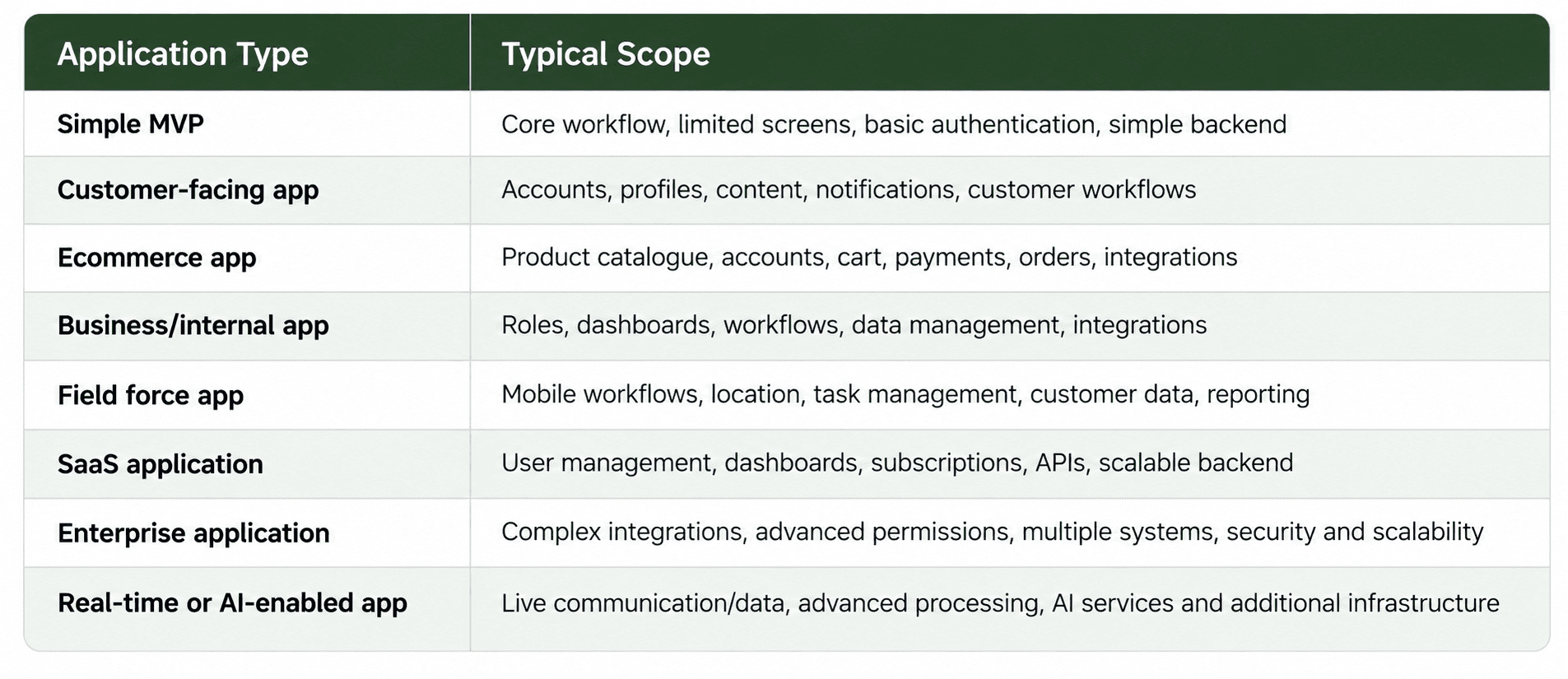
How Much Does It Cost to Build an MVP App in Australia?
An MVP — minimum viable product — focuses on the essential functionality required to validate a product idea or deliver a core business workflow. It's not just a smaller version of the final product. It prioritises what you actually need for that first release. When scoping an MVP, consider:
Number of screens and user journeys
iOS, Android, or cross-platform requirements
UI/UX design and prototyping
Authentication and user roles
Backend and database requirements
APIs and third-party integrations
Payments or subscriptions
Testing and deployment
Analytics and post-launch support
Starting with an MVP can help you validate your core proposition before investing in a larger feature set. It's a smart way to manage risk and learn what your users actually want.
Native vs Cross-Platform App Development Cost
Native App Development
Native development uses platform-specific technologies — Swift for iOS, Kotlin for Android. It can be the right choice when your application needs deeper platform-specific capabilities, specialised device functionality, or a highly tailored native experience.
Cross-Platform App Development
React Native and Flutter can support iOS and Android through a shared development approach. This can reduce duplicated effort in suitable projects, but both platforms still need appropriate testing, and some applications may require native components anyway. The right choice depends on your product requirements — not cost alone. Consider platform capabilities, performance expectations, integrations, maintenance, and your future roadmap before deciding.
What Is Included in Mobile App Development?
When you engage a software development company in Australian region, here's what a comprehensive project should cover:
Discovery and Planning: Requirements, scope, user needs, architecture, priorities, and development roadmap.
UI/UX Design: User journeys, wireframes, interface design, prototypes, interaction design, and design systems.
Application Development: Frontend/mobile development, backend services, databases, APIs, authentication, and business logic.
Integrations: Payment gateways, ERP, CRM, maps, analytics, communication platforms, and other systems.
Testing and Quality Assurance: Functional, device, integration, usability, performance testing, and issue resolution.
Deployment: Release preparation, app-store submission support, production deployment, and launch activities.
Post-Launch Support: Maintenance, operating-system updates, bug fixes, performance optimisation, monitoring, and future feature development.
Ongoing Post-Launch Expenses
Here's something a lot of people don't factor in: app development doesn't finish when the application is released. Ongoing operational and maintenance costs should be part of your business case from day one. As a rough planning figure, the research suggests budgeting 15% to 25% of your initial development cost per year for ongoing overhead. That's not a mandatory percentage — actual expenses depend on the application, infrastructure, traffic, integrations, support model, and required development work.
Hosting and Cloud Infrastructure
Indicative range: approximately AUD $50 to $500+ per month for systems like AWS or Firebase, depending on usage and architecture.
App Store and Platform Accounts
Apple Developer Account: approximately AUD $143 per year. Google Play Console registration: approximately AUD $30–$40 as a one-time fee. Platform pricing can change, so verify current fees before publication.
Maintenance and Operating-System Updates
Applications may need updates for new iOS and Android versions, device changes, security requirements, libraries, and third-party services. Maintenance can also include bug fixes, performance improvements, monitoring, and new features.
How to Reduce Mobile App Development Costs
Nobody wants to spend more than they have to. Here are some practical ways to keep costs under control: Start With a Focused MVP: Prioritise the core functionality needed for the first release. You can always add more later. Prioritise Features: Separate essential features from future enhancements. Be ruthless about what makes the cut for version one. Choose the Right Platform Strategy: Evaluate native and cross-platform options based on functionality, performance, maintenance, and roadmap. Define Requirements Before Development: A clear scope, user journeys, technical requirements, and integration plan can reduce avoidable changes. Changes mid-development are expensive. Design Before Building: Wireframes and prototypes help validate user flows before significant development effort. It's much cheaper to fix a design problem than a development problem. Plan Integrations Early: Identify ERP, CRM, payment, analytics, maps, and other integrations during discovery — not halfway through development.
Planning Your Mobile App Development Project
The most reliable way to estimate an application budget is to define the product before assigning a price to it. Start with the problem the app needs to solve. Identify the users and core workflows. Prioritise the features required for the first release. Document the platforms and integrations involved. Once these requirements are clear, a development partner can evaluate the design, architecture, development, testing, infrastructure, deployment, and support effort needed to take your application from concept to production.